Did you know about the DEC Rainbow and its unique features?

Click For Summary

Discussion Overview

This thread explores nostalgic memories related to early personal computing and copying technologies, particularly focusing on the DEC Rainbow computer and its unique features. Participants share their experiences with various machines and methods of duplication from the past.

Discussion Character

  • Anecdotal
  • Opinion-based

Main Points Raised

  • One participant discusses the DEC Rainbow's dual processors and its ability to boot as different machines, highlighting its unique features in the context of the early 1980s computer industry.
  • Another participant reflects on their experiences learning to type on a manual typewriter and expresses gratitude for advancements in personal computing.
  • Several users recall the use of mimeograph and spirit duplicator machines, sharing memories of the processes involved and the nostalgia associated with them.
  • One participant mentions working with Ditto machines in high school, emphasizing the challenges of making corrections during the typing process.
  • Another participant brings up the ScanTron system used in schools, connecting it to their experiences with standardized testing.

Areas of Agreement / Disagreement

Views differ on the fondness for past technologies, with some participants expressing nostalgia while others are relieved for modern improvements. No clear consensus emerges regarding the overall sentiment towards these older machines.

Contextual Notes

Participants share personal experiences from their past, particularly from the late 20th century, reflecting on the evolution of technology and its impact on their lives.

Who May Find This Useful

This discussion may resonate with individuals interested in the history of computing and those who have experienced the transition from older technologies to modern devices.

The_Kitchen_Guy
Silver Member
Messages
12,389
Back in the early 1980's, the computer industry was going through big changes, much of it driven by the rising popularity of the IBM-PC. Computer users were moving from large, centralized processing to distributed processing. The IBM-PC drove that migration.

Here's a parody thread where you can actually learn something.

IBM owned the MIS Information market, the second largest producer of computers was Digital Equipment Corporation, otherwise known as DEC.

The IBM-PC could be connected to IBM mainframes and was aimed at those customers. So, DEC needed a machine that could talk to DEC mainframes. DEC introduced their line of personal computers, three different micro-computers.

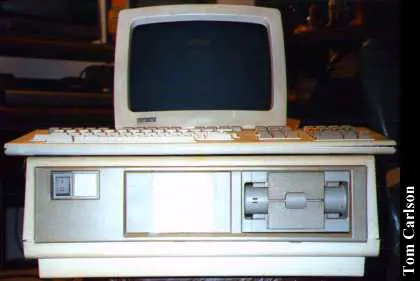
The most interesting of the three was called the Rainbow.

rainbow.jpg


Before the IBM-PC, most of the microcomputers in the marketplace were based on the Zilog Z-80 processor and ran an operating system known as CP/M. The IBM-PC was based on the Intel 8088 processor and ran an operating system that was a specially modified version of MS-DOS that was called PC-DOS. (Microsoft Disc Operating System and Personal Computer Disc Operating System, respectively, and both were the basis of Bill Gates' incredible wealth today.)

The DEC Rainbow had dual processors, both a Z-80 and 8088, and it could boot as a CP/M machine, MS-DOS machine, or as a DEC VT-100 terminal, one of the most popular (and standard) terminals in the industry. (If you're a real techno-geek, you'll want to know that it ran both the 8-bit and 16-bit versions of CP/M.)

Besides being able to boot as any one of three machines, it had some other unique and peculiar features. To save room (and probably money) the dual disc drive used one motor and head. Discs inserted into the upper drive were upside down, relative to the lower drive. Speaking of, the discs were proprietary to DEC and the machine did not have a FORMAT command. That meant users had to purchase diskettes from DEC, but more importantly, they could not be read by other maker's diskette drives.

Except that it could read and write specially IBM-PC formatted diskettes, though, which allowed the Rainbow to share data with IBM-PC's, something that was unique in the industry. (The diskettes had to be formatted single-sided to be read by DEC's goofy dual drive setup.)

It was a doomed system, though, as the IBM-PC became the standard on which all other personal computers were based. Technologically superior machines from DEC, HP, Texas Instruments and Wang fell by the wayside. The only choices we had were the first (and only, for awhile) "IBM Compatible" computer, the Compaq Portable, until the Apple Macintosh came out in 1984.

So, that's what I think of when I see Teresa's thread - another Rainbow PC.
 
You're bringing back old "not so fond" memories:)! Boy am I glad for all the improvements in the personal computer!!

I'm so old I learned to type on a manuel typewriter! My kids now say, "What is that?" But they are amazed when I sit at the computer and type 80 WPM:)! They always say, "How do you do that?" Of course my response is, "Years of practice." They don't like to hear that one!

P.S. Anyone else remember making copies w/ink and typed up templates (can't remember the name of that machine). It was a purple ink and you had to crank a large round drum. It could be very messy!
 
Oh yes, the joy of the mimeograph machines. Back when CC actually meant that you were using a piece of carbon paper to make a copy of a letter. I remember wanting to be just like my older sister and become a keypunch operator at IBM! Now that was a real dream job to aspire to!! My kids also look at me with amazement when they are standing around me when I am typing. I remember all those speed typing drills, where you were only allowed 3 errors or you had to start over! Oh, how about the fact that you couldn't just delete an error with a delete key.
 
  • Thread starter
  • #4
Actually, the purple output was from a spirit duplicator, commonly known as a Ditto machine, because Ditto was the primary manufacturer. Ditto could do colors other than purple, almost everything but black. Mimeograph created black text and graphics.Both required cutting a master on a typewriter, and if you wanted graphics, you had to manually draw them on the master. The master was heavy paper that had something like carbon paper behind it, reversed, so each keystoke created a mirror image on the back of the master. It wasn't carbon paper, though. It was a wax coating that, in the case of Ditto, brought out the color that was contained the master. In Mimeograph, the wax backer contained the color that was transferred to the master.The master was put on the drum of the duplicator, and when rotated, a wick soaked the master with a blend of isopropanol and methanol, which carried the ink to plain paper. The most common (read: cheapest) masters created purple. Masters were also available to make red, blue, green, yellow and brown. The process had a very unique odor to it, and if a teacher made a Ditto test paper just before class, we would all hold the paper up to our noses to inhale the unique fragrance. Of course, the stuff is toxic, but no one cared about that back then. Mimeography was similar in the way a master was cut, but it used different chemicals that produced a sharper output than Ditto, and it was black. The ink was contained in the wax coated backer. The typewriter had to have the ribbon removed so the sharp keys would make a better impression. If the keys for O P and D were really sharp, they could cut the stencil completely, resulting in a black blob instead of a letter. Cartoonists could make a color cartoon by moving the master to different color wax backers.Both spirit duplicators and mimeograph machines fell out of favor when photocopying got better and cheaper in the 1970's, but they are still used in third world countries where electricity may not be common, and for short runs, both systems are cheaper than photocopies.
 
When I was a senior in high school (1980) I worked for one of the teachers and typed worksheets and tests on those dang dittos and you had to scrap off the ink when you made an error and put another piece paper with the ink on it and retype it. I am so glad for computer!

Ann R.
 
  • Thread starter
  • #6
I've been to Champaign. I like to go there.It's as close to Normal as I've ever been.
 
I remember Dittos! That's how all our assignments in grade school were duplicated. And I remember making some, too, for projects and presentations. Anyone remember ScanTron, the school-use version of standardized testing? Some of my HS teachers were fond of those, because they could have the computer check tests.Back to KG's original post - I think one of the guys I knew in college had a Rainbow, or a similar machine.
 
chefann said:
I remember Dittos! That's how all our assignments in grade school were duplicated. And I remember making some, too, for projects and presentations.

Anyone remember ScanTron, the school-use version of standardized testing? Some of my HS teachers were fond of those, because they could have the computer check tests.

Back to KG's original post - I think one of the guys I knew in college had a Rainbow, or a similar machine.
All my high school tests were scantron tests!
 
pampchefrhondab said:
You're bringing back old "not so fond" memories:)! Boy am I glad for all the improvements in the personal computer!!

I'm so old I learned to type on a manuel typewriter! My kids now say, "What is that?" But they are amazed when I sit at the computer and type 80 WPM:)! They always say, "How do you do that?" Of course my response is, "Years of practice." They don't like to hear that one!

P.S. Anyone else remember making copies w/ink and typed up templates (can't remember the name of that machine). It was a purple ink and you had to crank a large round drum. It could be very messy!

I learned on an old manual too where you pushed the carriage back - I used to type 80 wpm on that. I STILL hit keys very hard and people laugh at me when I type on a PC. I still type about 80 wpm when really working at something. I don't think PC keyboards really sped me up at all - I type about the same...and actually make more mistakes on PC keyboards than on old typewriters.
 
  • Thread starter
  • #10
lissahope26 said:
All my high school tests were scantron tests!
They must have all come from Scantron, Pennsylvania.
 
Oh my gosh, yes the Ditto machine! I would have never remembered the name - thank you KG!!!

You are so right about the smell! It brings it back just thinking about it.

My school system must not have had much money, because we used them in the early 80's!!

I still hit the keys hard too Janet! The computer hasn't given me more speed either, but I do like having the numeric key board! I remember I had to take a typing test when I was re-hired by GTE (now Verizon). The HR rep. said, "Oh my gosh, nobody has even gotten this much done." I typed 81 WPM w/1 error on a Selectric Typewriter. She was amazed. I thought it was no big deal:)!
 

Similar Pampered Chef Threads

  • The_Kitchen_Guy
  • General Pampered Chef Chat
Replies
20
Views
2K
raebates
  • hollye44
  • Business, Marketing and Customer Service
Replies
2
Views
1K
Admin Greg
  • scottcooks
  • Products and Tips
Replies
2
Views
2K
Admin Greg
  • janezapchef
  • Business, Marketing and Customer Service
Replies
2
Views
2K
nascarcooker
Replies
4
Views
2K
tpchefpattie
  • cmdtrgd
  • Business, Marketing and Customer Service
Replies
25
Views
4K
raebates
  • cmackey
  • Pampered Chef Shows
Replies
4
Views
2K
Wildfire
  • COOKINWITHSHERRI
  • Pampered Chef Booths
Replies
2
Views
1K
Admin Greg
  • babywings76
  • General Pampered Chef Chat
Replies
5
Views
2K
Melissa78
Back
Top